

Picture a damp Saturday morning somewhere on the south coast. You have packed the picnic, the kids are half awake in hoodies, and the kettle has just boiled. You back down the slipway, start to launch, and the hull screeches over the bunks.
That horrible sound usually means the old carpet for bunks on boat trailers has turned into sandpaper. It might still look just about acceptable from the car park, but underneath it is holding grit, staying wet for days and slowly chewing into the gelcoat.
The good news is that this is not a mysterious boatyard job. With a free weekend, a handful of tools and a bit of patience, you can strip everything back, choose better materials and fit fresh carpet for bunks on boat trailers that glides the boat on and off.
This guide is written from a very human place. I have done this on a windy driveway with rain squalls sweeping in, and I have made most of the mistakes at least once. You will get quick checklists, clear steps, real examples of bunk carpet for boat trailer use and a few quiet warnings that might save your hull and your mood.
Quick checklist for choosing carpet for bunks on boat trailers

Before you even open a browser tab, it helps to do a little detective work. A fast pre flight check means you buy the right carpet for bunks on boat trailers the first time rather than sitting on the driveway halfway through the job, wishing you had ordered more.
Pre-purchase checklist
Grab a tape measure, a notebook and a marker, then crawl around the trailer. It is not glamorous, but these few minutes of careful measuring are the foundation of everything that follows.
- Measure the length of every bunk, not just one side, in case the trailer is not perfectly symmetrical.
- Measure the width and thickness of the timber so you know how far the carpet must wrap.
- Count how many faces of each bunk will be covered, usually two or three.
- Add generous allowance for wrapping the ends so no timber is left exposed.
Next, look up and think about the boat itself. A light aluminium skiff that potters around a quiet reservoir will treat carpet for bunks on boat trailers very gently. A beamy sports boat that pounds along the Solent in short chop will lean much harder on every square centimetre of bunk board carpet for boat trailer use.
Finally, be honest about storage. Does the trailer live indoors at a friendly sailing club, or does it spend winter on a windswept gravel yard with sea spray blowing over it. Long term exposure to rain, frost and winter sun all influence how tough your next carpet for bunks on boat trailers needs to be.
DIY fitting checklist
This is a satisfying job, but it is still fairly physical. You will kneel on tarmac, wrestle with rusty bolts and lift heavy boards. If that sounds like your idea of a good Saturday, you are in the right place. If not, rope in a patient friend with strong knees.
Gather tools before you touch a single bolt. A realistic starter kit looks like this.
- Socket set and spanners that match the trailer hardware.
- Strong staple gun with stainless or monel staples.
- Drill, drill bits and a countersink bit for new holes if needed.
- Sharp craft knife with a stack of spare blades, plus a straight edge.
- Safety gear, including decent gloves and eye protection.
Check where you will support the boat while the bunks are off. Some people ask their local yard to hold the boat in slings for an afternoon. Others use heavy wooden blocks and stands on a firm driveway. Whichever route you choose, decide who is in charge of safety calls and agree a simple script such as “chocks in, handbrake on, stands placed, then bunks off”.
When to consider upgrading bunks or switching to alternative support systems
It is very tempting to focus just on the fabric. Yet sometimes fresh carpet for bunks on boat trailers is like putting new tyres on a car with rotten suspension. You will feel an improvement, but you will not fix the underlying problem.
While the boat is lifted and you can see the boards, look for deep grooves, blackened soft patches or splits at bolt holes. If you can flex a bunk with your hands, the timber is probably past its best. In that case a new set of boards and carpet for boat trailer bunks is a smarter way to spend your money.
You might also notice recurring support issues. Perhaps the boat always wants to sit slightly twisted, or one corner of the hull seems to do the hard work every time you recover. These are hints that you could adjust the bunk positions or even shift to a different support style, such as additional keel rollers or synthetic covers that replace traditional carpet for bunks on boat trailers entirely.
How to choose carpet for bunks on boat trailers: materials, pile and backing
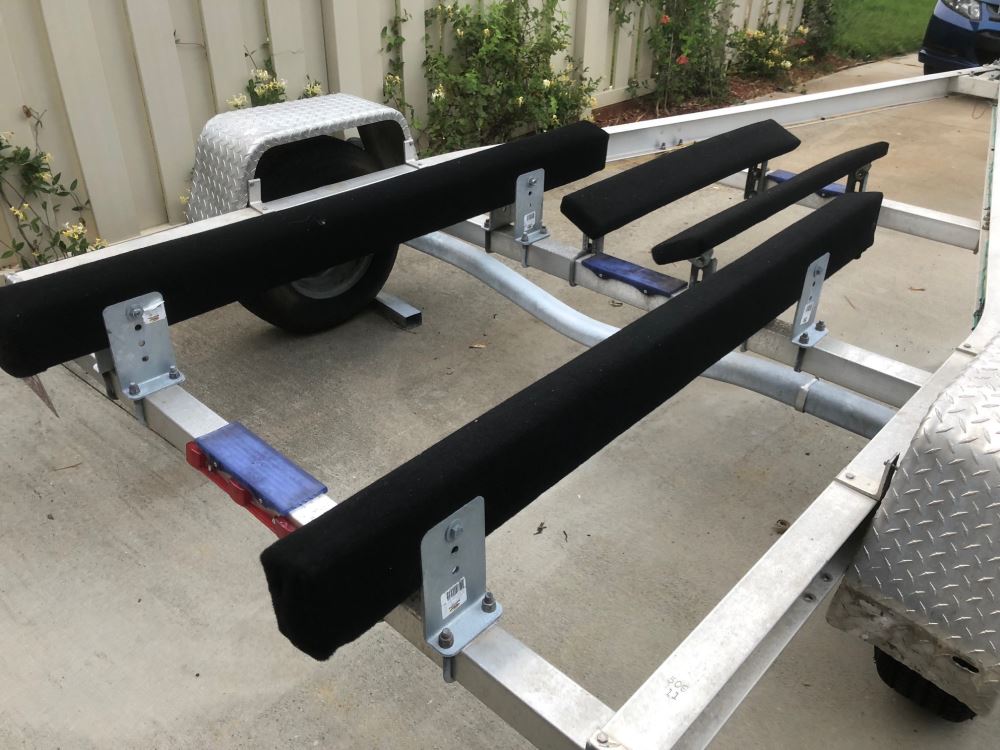
Once you know your bunk sizes and how hard life is for your trailer, it is time to look closely at the material itself. The right carpet for bunks on boat trailers needs to be kind to the hull, tough with grit and weather, and practical for the way you launch.
Marine-grade synthetic vs “whatever’s left in the garage”
You are not alone if you have looked at an old piece of indoor carpet and thought, “That will probably do”. For a week or two it might. Then the backing starts to break down, the fibres stay wet in cold weather and the pile traps sand like a sponge.
Marine grade synthetics are built for exactly this job. The fibres absorb very little water, so carpet for bunks on boat trailers dries more quickly between trips. The backing is chosen to flex instead of cracking when it is soaked one day and frozen the next, which is pretty standard British winter behaviour.
If your boat only ever sees a calm Scottish loch once a year, you might get away with improvisation. For anyone towing along salted roads and launching in estuaries full of fine grit, proper bunk carpet for boat trailer use is well worth the extra cost.
Weight, thickness and pile height for carpet for bunks on boat trailers
Manufacturers often list weight per square metre or ounces per square yard. Higher numbers usually mean more fibre, and more fibre means better cushioning and longer life. Very thin material looks tidy when new but often wears through at the edges within a season or two on heavy craft.
Pile height is a balancing act. Longer pile can feel luxurious when you press it with your fingers. Under a heavy hull, though, those long fibres fold over and hang on to grit. Medium pile carpet for bunks on boat trailers supports the hull more evenly and tends to rinse clean with a simple hose down.
Think about compression too. When the boat sits on the trailer for months, the pile will settle. If the material is too soft, it ends up as a thin pad with deep grooves and high ridges. Choosing slightly firmer carpet for boat trailer bunks helps avoid that, especially with bigger rigs.
Backing options: rubber, foam and felt for bunks on boat trailers
Turn a sample over and you will usually see rubber, foam or felt on the back. Rubber backed carpet for bunks on boat trailers tends to grip timber well and resists water. Foam can offer gentle cushioning but needs to be dense enough that it does not crumble under staples.
Felt backings wrap easily and look very neat on corners, which is why some people love them. The trade off is that they sometimes hold moisture. In a wet British winter that moisture sits against the bunk boards for weeks, and timber hates that.
To make the choice clearer, here is a simple comparison.
| Backing type | Best suited for | Pros | Watch outs |
|---|---|---|---|
| Rubber | Regular coastal launching | Good grip on wood, sheds water, stays flexible in cold | Can be slightly heavier, needs sharp staples to penetrate cleanly |
| Dense foam | Lighter boats on gentle slipways | Nice cushioning, easy to cut and wrap | Cheap foam may crumble or soak water over time |
| Felt | Indoor stored trailers or lake use | Very easy to form around edges, usually looks smart | Can hold water against timber, less ideal for year round outdoor storage |
Whichever backing type you prefer, bend a small piece sharply in your hand. Good carpet for bunks on boat trailers feels flexible yet tough. If the backing cracks or sheds dust at this stage, it will not age gracefully on a trailer that lives outdoors.
Colour and UV resistance considerations
Colour feels like a style choice, and to a degree it is. There is something pleasing about matching a soft grey carpet for bunks on boat trailers to a pale hull. Yet colour also affects how easy it is to keep an eye on wear.
Very dark shades hide marks and algae stains, which is nice, but they also hide early damage and absorb more heat on sunny days. Lighter colours show grime but make it easier to spot bare patches before they turn into trouble. UV stability matters as well. Even a northern harbour gets sharp sun between the showers, and cheaper dyes tend to fade and chalk.
Matching carpet for bunks on boat trailers to your boat size and launch frequency
Now step back and look at the bigger picture. A small dayboat on a gentle river is not asking as much of carpet for bunks on boat trailers as a twin engine cruiser shuttling out of a tidal marina twice a week. Your usage should drive your choice.
For frequent, high load launching, durability comes first. Choose marine grade carpet for boat trailer bunks with medium pile and clear bunk use in the description. Pair it with solid boards and stainless fixings. You might not notice anything dramatic on day one, but you will still be happy with it three seasons later.
If your boat only sees a handful of trips each summer and the trailer lives in a barn, you can lean a little more towards comfort. Slightly softer carpet for bunks on boat trailers can give a forgiving feel without being worked to death. Just remember the boat still sits on those bunks all winter, so strength still matters.
Carpet for bunks on boat trailers: 9 product picks (by brand and use case)
Once you know your bunk sizes and how often you launch, it helps to look at real examples of carpet for bunks on boat trailers. The list below walks through nine options, from simple marine carpet rolls to full synthetic covers, so you can match each product to how you actually use your trailer and choose the most suitable bunk carpet for boat trailer set-ups.
-
CE Smith Trailer Carpet Roll 11″ x 12′ (black)
This CE Smith roll is a straightforward, marine-focused option aimed squarely at trailer bunks. The 11 inch width is sized to work neatly with common 2×4 and 2×6 bunk boards, giving just enough overhang on each side so you can wrap the timber and staple underneath without leaving exposed edges. If you currently have worn or fraying carpet for bunks on boat trailers and want a like-for-like replacement that behaves predictably, this is a reliable starting point.The backing and pile are designed for regular immersion and drying rather than indoor use, so it resists rotting and shedding better than repurposed household carpet. In practice, this kind of roll suits owners who launch and recover several times a month and want their bunk carpet for boat trailer duties to be tidy, grippy and easy to install with basic tools.
It is especially useful if you plan to keep your existing timber and hardware, but want fresh, consistent coverage along the full length of the bunks without having to piece offcuts together.
-
CE Smith Marine Grade Blue Bunk Carpet 11″ x 12′
This blue marine carpet is similar in size to the black roll but uses a slightly plusher pile with a velvet-like finish. That texture helps shed small stones, mud and shell fragments when you back into the water, so less grit is trapped between the carpet and your hull. The shade of blue can also make it easier to spot wear marks and damaged spots, compared with very dark carpet for boat trailer bunks where issues sometimes hide until they are quite advanced.As with the black roll, the 11 inch width is a good fit for standard bunk boards, so you can work quickly down the length of each board with consistent wrapping and stapling. If your trailer spends a lot of time outdoors, the marine-grade fibres and backing cope better with UV exposure than generic indoor carpet, extending the life of the bunk board carpet for boat trailer use.
This is a sensible choice for owners who want a slightly more “finished” look than basic black, while still keeping the installation process simple for a weekend DIY project.
-
CE Smith Bunk Board Carpet Range (11″ and 18″ options)
If your bunks are wider, longer or a mix of sizes, the broader CE Smith bunk board carpet range gives you more flexibility. Within the range you can choose both 11 inch and 18 inch rolls, which is useful if you have deep bunks under the keel or extra-wide supports towards the stern. Having multiple widths available means you can match each piece of carpet for bunks on boat trailers to a specific board rather than wasting material trimming down oversized rolls.This product line is well suited to trailer refits where you are re-planking the bunks and want clean, continuous coverage. It also helps if you are dealing with more complex layouts, such as staggered side bunks or additional support boards for a heavier fibreglass hull. When you treat the whole range as a system, it becomes easier to design bunk board carpet for boat trailer layouts that fully support the hull shape instead of leaving bare patches or joints in high-stress areas.
For many owners, the appeal here is consistency: every board is covered with the same material, pile and colour, which gives the trailer a tidy, professional finish and makes future repairs more straightforward.
-
Cuda Premium Marine Bunk Carpet 18″ x 15′
This premium roll offers a generous 18 inch width, which can be a game changer on wider or deeper bunks. Instead of trying to stretch narrow carpet across a thick board, you have ample material to wrap fully around the timber and create a cushioned, double-layered contact surface in the most heavily loaded zones. That extra coverage is particularly valuable on trailers carrying larger cabin boats, where the hull presses firmly onto the bunks during launching and recovery.The pile is designed for demanding marine use, so it stands up well to repeated wet–dry cycles without compacting too quickly. If you have already worn through cheaper carpet for boat trailer bunks in a season or two, upgrading to a heavier roll like this can reduce how often you need to strip and recover the boards.
It is also handy when you want to avoid joints along the length of the bunk. A single continuous strip from this roll allows you to wrap the board in one go, which reduces the risk of the hull catching on seams or overlaps when the boat slides on and off the trailer.
-
Tie Down Marine Bunk Carpet 11″ x 12′ (value roll)
Tie Down’s value roll is aimed at owners who want a sensible balance between cost and durability. It is lighter than some premium offerings but still a step up from generic DIY-store carpet. The roll is large enough to recover a pair of modest bunks, making it well suited to small aluminium runabouts, dinghies and lighter fishing boats that do not place extreme loads on the trailer.This is often the kind of carpet for bunks on boat trailers that people choose when they are tidying up an older trailer before selling a boat, or when they want a practical improvement without committing to a full rebuild. Provided you seal the timber and use corrosion-resistant staples, you can expect a noticeable improvement in appearance and grip compared with heavily worn older material.
Because it is relatively affordable, it also makes sense as an interim option: you can refresh the look and function of your bunk carpet for boat trailer use now, while planning a more extensive upgrade to the trailer structure later.
-
Gatorbak Synthetic Bunk Covers (standard series)
Gatorbak’s standard series covers mark a clear shift away from traditional carpet for bunks on boat trailers. Instead of wrapping fabric around timber, you slide these synthetic covers over the boards to create a grooved, non-absorbent surface that drains water and releases sand and grit readily.This design is particularly useful if you launch on gritty or sandy ramps, where ordinary carpet can trap abrasive particles that then scour the hull every time you load the boat. With Gatorbak covers, you can hose down the bunks after use and visibly see debris wash away, reducing the risk of fine scratches on painted or gelcoat finishes.
Standard covers are a good match for general leisure use: weekend towing, mixed weather and regular but not extreme duty. They work best for owners who are tired of dealing with soggy, smelling carpet for boat trailer bunks and want something that looks more modern and is easier to keep clean over multiple seasons.
-
Gatorbak E-Plus Full Synthetic Bunk Cover Kit
The E-Plus kits take the Gatorbak concept further, with a deeper, more aggressive profile and full synthetic construction designed for heavier use. These kits are intended for trailers that work hard throughout the season, carrying larger or more valuable boats that you want to protect from repeated rubbing on wet fabric.Instead of viewing bunk maintenance as a recurring “strip and re-staple” job with rolls of carpet for bunks on boat trailers, the idea here is to fit the covers once and then simply inspect them periodically. The material is formulated to resist UV exposure and repeated dunking, so it gives a longer service life in demanding conditions.
This option is particularly attractive if you already know that you wear through ordinary carpet quickly, or if you store the trailer outdoors in strong sun and are tired of seeing faded patches and worn-through spots after only a couple of years.
-
Caliber BunkWrap (bulk rolls and kits)
Caliber’s BunkWrap is another synthetic alternative to fabric carpet for bunks on boat trailers. It fixes directly over bare timber bunk boards and creates a hard-wearing, low-friction surface that the hull can slide on. Rather than absorbing water, the material sheds it quickly, so the bunks do not stay saturated after a day on the water.The low-friction behaviour makes launching and loading smoother, especially for heavier boats or when you are working alone. You do need to be careful to keep the winch strap and safety chain secured until the boat is backed into the water, because the hull can move more readily than on high-friction carpet, but once you understand that characteristic it becomes a helpful feature rather than a drawback.
Bulk rolls and kits allow you to adapt the system to different trailers, so you can replace multiple runs of carpet for boat trailer bunks with a more durable wrap that is easier to rinse clean and less likely to hold grit or algae.
-
Caliber Bunk Wrap Cool Grey 2″ x 4″ x 16′ Roll
This specific Caliber roll is sized for standard 2×4 bunks and comes in a neutral cool grey finish. The 16 foot length gives you enough material to cover a pair of typical side bunks on a small to medium trailer without needing joins. It is a neat way to upgrade a single-axle trailer where you are happy with the basic bunk layout but want a cleaner, longer-lasting surface than traditional carpet.As with other BunkWrap products, you fit it once over the timber and then simply monitor the surface for wear, rather than planning another round of bunk board carpet for boat trailer stapling in a couple of seasons. It is a strong choice if you use your trailer often, store it outdoors and want an easy-to-rinse surface that does not hold moisture or dirt.
For many owners, this kind of wrap becomes the point where they stop thinking of replacing carpet for bunks on boat trailers as a regular chore and instead treat the bunks as a long-term, semi-permanent part of the trailer that only needs occasional inspection and cleaning.
Taken together, these products show the main paths you can take: simple rolls for quick refreshes, wider and heavier materials for bigger hulls, and synthetic systems that completely replace traditional carpet for bunks on boat trailers. By weighing how often you launch, how heavy your boat is and how much maintenance you want to do, you can choose the bunk carpet for boat trailer arrangement that will protect the hull and make ramp days less stressful.
Step-by-step guide to replace carpet for bunks on boat trailers
Once you have the materials stacked in the garage and decent weather on your side, it is time for the part that feels like a proper project. Take it slowly, keep things safe and do not worry if your first bunk takes longer than you expected. By the second one you will be moving with confidence.
Tip: watch the video once before you start, then keep your phone somewhere safe so you can glance at the sequence while working on your own carpet for bunks on boat trailers.
Step 1: How to lift boat off trailer to replace bunks
If you have access to a club crane or yard hoist, use it. Paying for an hour of sling time is not wasted money. The boat hangs safely, you roll the trailer out, tackle the bunks at a comfortable working height, then roll back in for lowering.
At home you can do the job with blocks and stands, but you must be careful. Pick a firm, level surface. Chock the trailer wheels front and back, apply the handbrake, and take a quiet moment to plan the sequence. Then gently raise or lower the jockey wheel to shift a little weight onto blocks under the keel.
Add further supports under strong areas near the bow and stern, never under thin panels. A simple call and response system such as “up a turn”, “down a turn” and “stop” keeps everyone calm. Remember the goal is not to lift the boat clear of the trailer in one go, but to create just enough space to remove the boards and the tired carpet for bunks on boat trailers.
Step 2: Unbolt the bunk boards and strip the old carpet for bunks on boat trailers
Once the hull is fully supported on the blocks and stands, start unbolting. Some hardware will undo with a satisfying clunk. Other bolts may fight back after years of salt and neglect. If you round a nut or shear a corroded fixing, do not panic. Plan to replace problem pieces rather than reusing them.
Carry each board to trestles or a makeshift bench. Use a sharp knife to slice along the underside of the old covering, then peel it back. The weight and smell of the old carpet for bunks on boat trailers can be revealing. Many people only truly appreciate how waterlogged and sandy it has become once it is off the wood.
Strip as much of the old fabric, backing and staples as you can. Every fragment you leave will get in the way of a clean wrap. This is slightly tedious work, but it sets you up for a neat finish later on.
Step 3: Inspect and repair the timber before new carpet goes on
Now take the time to play detective. Press a screwdriver gently into the grain along the length of each board. Any area that feels soft or spongy is a candidate for replacement. Pay particular attention to where the boards sit in brackets and where old waterlogged carpet for bunks on boat trailers might have trapped moisture.
If you find long runs of sound timber with only small problem patches near the ends, you may be able to cut out and replace just those sections. For heavily loaded boats, though, full length replacements are often wiser. You want the structure under the carpet for boat trailer bunks to be trustworthy.
Once you are happy with the board condition, lightly sand the corners. Sharp edges are the enemy of fresh carpet. A gentle round over means the load is spread out and the covering is far less likely to wear through at the corners in the first season.
Finally, seal bare timber with preservative or thin epoxy, especially on the end grain. Let it dry properly. This is the quiet, slightly boring stage that adds years to the life of your new carpet for bunks on boat trailers.
Step 4: Pre-fit bolts so the heads sit under the new carpet
Lay each board where you can see both faces. Decide which side will support the hull and which will take the fixings. For coach bolts, drill or clean out the holes, then tap the heads in from the hull side until they sit fractionally below the surface.
Run your fingers over the area. You should not feel any hard bumps that might press into the pile of the carpet for bunks on boat trailers once wrapped. If a head stands proud, take the time to countersink slightly.
Test fit each board on its bracket without any covering. Check that the bolts line up, that the brackets still adjust properly and that you can reach all the nuts with a spanner when carpeted. Once you are confident, remove the boards again and move on to cutting fresh material.
Step 5: Cut the new carpet for bunks on boat trailers to size with generous end overhang
Roll out the new material pile side down on a clean surface. Place a board on top as a template. Use a straight edge and marker to outline a strip wide enough to cover both main faces and wrap onto the underside with comfortable overlap.
For length, allow plenty of spare at each end. When the boat snugs up tight to the winch post, the first contact is often at the very ends of the bunks. Properly wrapped ends protect the hull. Short carpet for bunks on boat trailers that barely folds over offers much less defence.
Cut carefully along your lines with a sharp blade, replacing it as soon as it starts to drag. Clean cuts make for neat seams and help the carpet for boat trailer bunks sit flat without frayed edges trying to escape the wrap.
Step 6: Wrap the first side and staple a straight line
Lay the board back on the strip. Pull one long edge up and over onto the underside. Starting in the centre, fire in a row of staples along a straight line parallel to the edge. Work towards each end, smoothing the pile on the contact face as you go so the carpet for bunks on boat trailers stays wrinkle free.
Pause every few staples to flip the board and check the visible side. If you see ripples or diagonal tension lines, pull those staples and reset. This might feel fussy, but it saves you from living with annoyingly uneven bunk board carpet for boat trailer use for years.
Once the first row is in and you like how the face looks, add a second staggered row of staples between the first row and the edge. This spreads the load and helps the carpet for bunks on boat trailers stay locked in place.
Step 7: Fold, tension and staple the second side and both ends
Now pull the remaining long edge tight across the underside. You want firm tension but not so much that you crush the pile flat. Again, staple from the centre outwards. When you reach the ends, fold the surplus neatly like wrapping a present, tucking the corners in rather than bunching them.
Use extra staples around the folded ends. These areas see more knocks when you launch too deep or nudge the bunks on the ramp. The stronger the fixings here, the better the carpet for bunks on boat trailers will stand up to clumsy days.
Run your hands along each face with your eyes closed. If you feel anything sharp, lumpy or oddly thin, investigate. It is completely normal to tweak a few folds or add a stray staple at this point to get things feeling just right.
Step 8: Re-fit bunk boards, adjust height and alignment, and test-load the boat
Carry the finished boards back to the trailer and mount them loosely in their brackets. Snug the nuts down just enough that the bunks hold their position but can still be nudged by hand. This gives you room to fine tune how the hull sits on the new carpet for bunks on boat trailers.
Lower the boat slowly back onto the trailer, watching from the side if possible. Check that each bunk shares the load and that there is continuous contact along the length. If a board seems to carry all the weight at one end, adjust the bracket angles until the support feels even.
Once everything looks and feels right, fully tighten the hardware. Then tow gently to a quiet slipway for a test launch. You will know you have nailed it when the boat slides off in a smooth, controlled way and recovers without any juddering or worrying noises from the bunks.
Common mistakes with carpet for bunks on boat trailers

By now you are well ahead of most casual trailer owners, but it still helps to know the typical pitfalls. These are the habits that quietly ruin both the new carpet for bunks on boat trailers and, eventually, the hull.
- Using old indoor carpet just because it is free, then watching it rot and hold grit against the gelcoat.
- Cutting pieces too short, leaving bare timber at the ends where the boat first lands.
- Pulling the wrap so tight that the pile crushes and the backing strains at the staples.
- Using light duty staples or too few fixings so the covering creeps, bunches and tears.
- Skipping the rinse after salty trips and letting sand and shell fragments live in the pile.
None of these mistakes come from bad intentions. They mostly come from rushing. Taking an extra half hour now to check lengths, tension, fixings and rinsing routines keeps your new carpet for bunks on boat trailers, and every secondary carpet for boat trailer bunks you might fit in future, in much better shape.
In the end this whole process is about quiet confidence. When you reverse down a busy slipway on a bank holiday, you want to think about wind, tide and traffic, not whether the bunks will scrape or the boat will stick halfway on. A well chosen, carefully fitted layer of carpet for bunks on boat trailers turns all that into background. It lets you focus on what really matters, which is getting out on the water with your favourite people, exploring the coast and coming home with stories rather than repair bills.
Frequently Asked Questions About Carpet For Bunks On Boat Trailers
1. How often should I replace carpet for bunks on boat trailers?
There is no single expiry date, but most boaters find a realistic range is between two and five seasons. Light river use with indoor storage sits at the longer end, while regular salty trips and outdoor parking push you towards more frequent changes.
Use your eyes and fingertips rather than the calendar. When the pile feels flat and harsh, you can see backing peeking through or the carpet smells musty even when dry, it is time to plan a replacement before your next long tow.
2. Can I use normal indoor or automotive carpet on my trailer bunks?
You can, but it is usually a false economy. Indoor and automotive carpets are designed for dry, relatively clean environments, not constant soaking and gritty slipways. They tend to hold water, trap sand and break down very quickly on bunk boards.
Marine grade carpet for bunks on boat trailers is made to drain, resist UV and shrug off repeated wet and dry cycles. It is more likely to protect both your hull and the timber underneath, which is really what you are paying for.
3. Do I really need to take the boat off the trailer to change the bunk carpet?
For a safe and thorough job, yes, the boat should be fully supported somewhere other than the bunks you are working on. Trying to squeeze new carpet for bunks on boat trailers under a part loaded hull usually leads to rushed work and missed damage on the boards.
You can use a yard lift, club crane or careful blocking at home for smaller boats. Whichever method you choose, the key is stable support, enough space to remove each bunk and enough time that you are not tempted to cut corners.
4. What is the best way to fix carpet for bunks on boat trailers in place?
Most DIY boaters in the United Kingdom stick with stainless or galvanised staples along the underside of the bunk. Staples are quick, neat and easy to remove when you next change the covering. Screws can be used at the ends but their heads must be fully buried.
Adhesive can be a useful helper rather than the only fixing. If you use glue, choose a marine safe product that will not attack the backing and only apply it in thin, well ventilated lines so moisture can still escape from the timber beneath.
5. How can I stop sand and grit scratching my hull through the bunk carpet?
The real trick is to minimise how much grit stays in the material after each trip. A quick rinse with fresh water in the car park or on the driveway flushes out sand before it has time to work deep into the weave of carpet for bunks on boat trailers.
It also helps to keep an eye on the high load zones. Regularly inspect the areas where the bow first contacts the bunks and where the chines rest. If the pile looks thin there, patch or replace it before grit and bare wood have a chance to mark the hull.
References
- Palmer, E. How to completely replace your boat trailer bunk carpets. Better Boat.
https://betterboat.com/blogs/video-reviews/how-to-completely-replace-your-boat-trailer-bunk-carpets
- Sailrite Enterprises Inc. How to replace boat trailer bunk carpet. Sailrite.
https://www.sailrite.com/Boat-Trailer-Bunk-Carpet-Replacement-Video
- Mercury Marine. Quick Tip: How to replace the carpet on your boat trailer bunks. Mercury Marine Dockline.
https://www.mercurymarine.com/us/en/lifestyle/dockline/quick-tip-how-to-replace-the-carpet-on-your-boat-trailer-bunks
- ’Cuda Powersports. Replacing your boat trailer bunk boards: A complete guide. ’Cuda Powersports.
https://cudapowersports.com/blogs/news/replacing-boat-trailer-bunk-boards
- Matthew, M. Eco-friendly boating: How to protect our waters while enjoying the ride. Westland Covers.
https://westlandcovers.com/blog/post/eco-friendly-boating
Small Yacht Interior Design: A New Year Reset to Make a 30–45ft Cabin Feel Bigger
The Ultimate Winter Yachting Guide: Safety Tips, Gear, Destinations & Planning
Learn to Sail a Catamaran: The Monohull-to-Multihull Conversion Guide
Comments are closed