
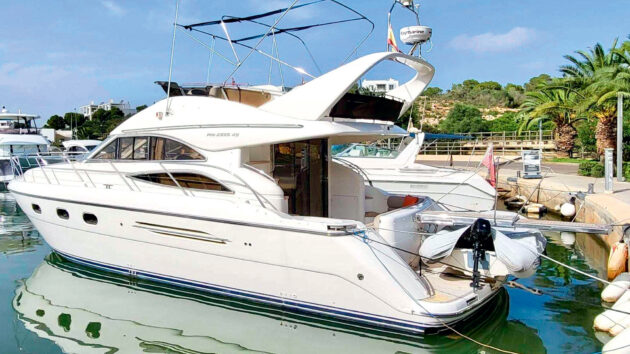
You might have seen those glossy marina walk-through where a 37-footer looks oddly spacious, like someone has quietly removed half the stuff when the camera arrived. Then you step onto your own boat in the UK with a damp duffel and a bag of groceries, and the saloon somehow feels like a narrow corridor. You’re not alone.
Here’s the bit people rarely say out loud. Small yacht interior design is not a “style” problem first. It’s a habit problem. If your companionway becomes a drop zone, if the table becomes a charging station, if the wet kit has no agreed home, your cabin will always feel smaller than it is.
So this is a human, real-life reset. Not precious. Not a showroom. It’s the kind of Small Yacht Interior Design that survives a windy Friday night arrival, a wet dog, a rushed bacon sandwich, and that moment you realise you left the torch somewhere “safe”.
Small Yacht Interior Design Master Table: The 10-Minute Reset Plan (30–45ft Cabins)
| What you want the cabin to feel like | Fast action (10 minutes) | Where you do it onboard | What you’ll need | Why it works (the real reason) | Effort | Typical UK spend | Best section to read next |
|---|---|---|---|---|---|---|---|
| Bigger, calmer, less “corridor” | Do the photo test, then clear the saloon table into one daily tray | Companionway and saloon | One tray or shallow basket, bin bag | Visual noise shrinks a space faster than furniture ever will | Low | £0–£15 | Light and colour |
| Easy movement with two people onboard | Apply “nothing lives on the steps”, create one arrival drop zone | Companionway steps | One drop basket, one hook strip (optional) | Flow is what your body reads as “space” on a small yacht | Low | £0–£25 | Improving flow |
| Brighter without harsh glare | Switch to warm LEDs and add one low glow light source | Saloon, galley, reading spots | Warm LED bulbs/strips, small lamp or low-level strip | Layered light reduces shadows, and shadows make cabins feel tight | Low | £15–£80 | Light and colour |
| A galley you can actually use | Clear one work surface, hang the “daily grab” items on a rail | Galley | Rail with hooks, one caddy for washing-up kit | Counter space is your working space, if it’s blocked you feel cramped | Low | £10–£60 | Improving flow |
| No more loose bottles rolling around | Put toiletries into one waterproof caddy, add two hooks | Heads | Waterproof caddy, hooks, small basket | Small rooms feel bigger when they are simple and predictable | Low | £10–£40 | Improving flow |
| Less clutter returning after every trip | Label three lockers: Guest, Owner, Turnaround supplies | Saloon lockers, galley lockers | Label tape, marker, 10 minutes of honesty | Clutter returns when people don’t know where things live | Low | £3–£15 | Storage-first |
| Provisioning that doesn’t explode your storage | Create a Yacht provisioning list and stick a Boat provisioning template inside a locker lid | Galley and food lockers | Printed sheet, pen, clear tubs (optional) | Provisioning becomes calmer when quantities match real locker space | Low to medium | £0–£40 | Storage-first |
| Hosting that feels easy, not chaotic | Set up one snack and water tray, and one charging basket | Saloon | Tray, basket, multi-port charger | Guests relax when they know what they can use and where it goes back | Low | £10–£70 | Hosting-ready |
| Less damp, less smell, more “fresh cabin” | Define a wet kit hanging zone with a drip tray, then do a 5-minute wipe and air routine | Near companionway, heads, lockers | Hooks, drip tray, microfibre cloth | Damp creates “avoid zones”, and avoid zones make cabins feel smaller | Low | £5–£35 | Maintenance habits |
| Smarter spending at Yacht Chandlers | Walk in with a list, and buy only what fixes a repeat pain point | Ashore, then back onboard | Your list, your measurements, one calm decision | Buying “nice things” rarely beats fixing flow, light, and damp control | Low | Controlled by you | Budgeting |
| A cabin that stays “big” all season | Weekly reset: clear surfaces into tray, empty drop zone, wipe condensation, crack lockers open | Whole cabin | 10 minutes, one routine, one habit | Consistency beats perfection in any Small Yacht Interior Design plan | Low | £0 | Maintenance habits |
A 2026 New Year reset for small yacht interior design: making a 30–45ft cabin feel bigger

Before you buy anything, give yourself one clear goal: make the cabin resettable. If you can restore the saloon to calm in under ten minutes, it will feel bigger all season. That’s the core of small yacht interior design that actually works.
This reset also has a quiet bonus. Once your cabin feels bigger and more organised, your onboard routines improve too. Even things like a yacht provisioning list become easier, because you can see what you have, where it lives, and what actually gets used.
The five-minute audit to spot what’s shrinking your cabin
Do this as soon as you arrive onboard, before you start “tidying”. You want the cabin in its honest state, because that’s where the clues live.
First, stand in the companionway and take a quick photo of the saloon. If it looks busy in a phone photo, it feels smaller in real life. Photos do not do your brain’s helpful “ignore the clutter” trick.
Next, do the two-hand walk. Hold a mug in one hand and your phone in the other. Walk from companionway to forecabin and back. If you have to twist sideways, step over bags, or put things down to get past, you’ve found your pinch points.
Then write down just three irritations. Not ten. Three. The best small yacht interior design changes are usually the ones that remove repeat annoyances.
| Zone | Quick test | What “small” feels like | Fix you can do today |
|---|---|---|---|
| Companionway | Can two people pass without shuffling? | Steps stacked with bags and shoes | “Nothing lives on the steps” rule + one drop basket |
| Saloon table | Can you clear it in 10 seconds? | Permanent pile of chargers, snacks, papers | One daily tray, everything else stows |
| Galley | Can you make tea without moving five items? | Counter used as storage | Hanging rail + one clear counter rule |
| Heads | Can you use it without knocking bottles? | Loose toiletries everywhere | Waterproof caddy + two hooks |
| Forecabin | Can you get into bed without moving bags? | Bunks become storage shelves | Under-berth bins + “sleep kit” pouch |
Your reset order of operations: light, flow, storage, then styling
This is where a lot of competitor articles lose the plot. They start with soft furnishings and “themes”. That can look nice, but it won’t keep a cabin feeling bigger.
In small yacht interior design, the order matters because each layer supports the next. Light changes perception. Flow changes how it feels to move. Storage prevents clutter returning. Styling is the final polish, once the system is already working.
- Light: reduce shadows and harsh glare first.
- Flow: clear walkways and remove pinch points.
- Storage: give everyday items obvious homes.
- Styling: add warmth without adding clutter.
A very practical crew call that saves your cabin in ten seconds is: “Bags there, shoes here, wet kit hangs aft.” Say it with a smile. People like being told what to do when the boat is small, because it removes awkwardness.
Can you remodel a yacht in the 30–45ft range, and what changes make the biggest difference first?
Yes, you can remodel, but please do not start by ripping things out because a blog told you to. On a 30–45ft yacht, bulkheads, access panels, and weight distribution are real constraints. Some “interior upgrades” create new problems, like blocked access or trapped damp.
The biggest wins first are usually lighting, reflectivity, and friction removal. In other words, the cabin feels bigger because your eyes see more space and your body moves through it more easily. That’s small yacht interior design as lived reality, not décor.
If you do want bigger work, prioritise reversible changes first. It’s a lot less painful to swap lighting and storage systems than to undo joinery that looked lovely on day one and annoying on day thirty.
Light and colour in small yacht interior design: the fastest way to “add space”
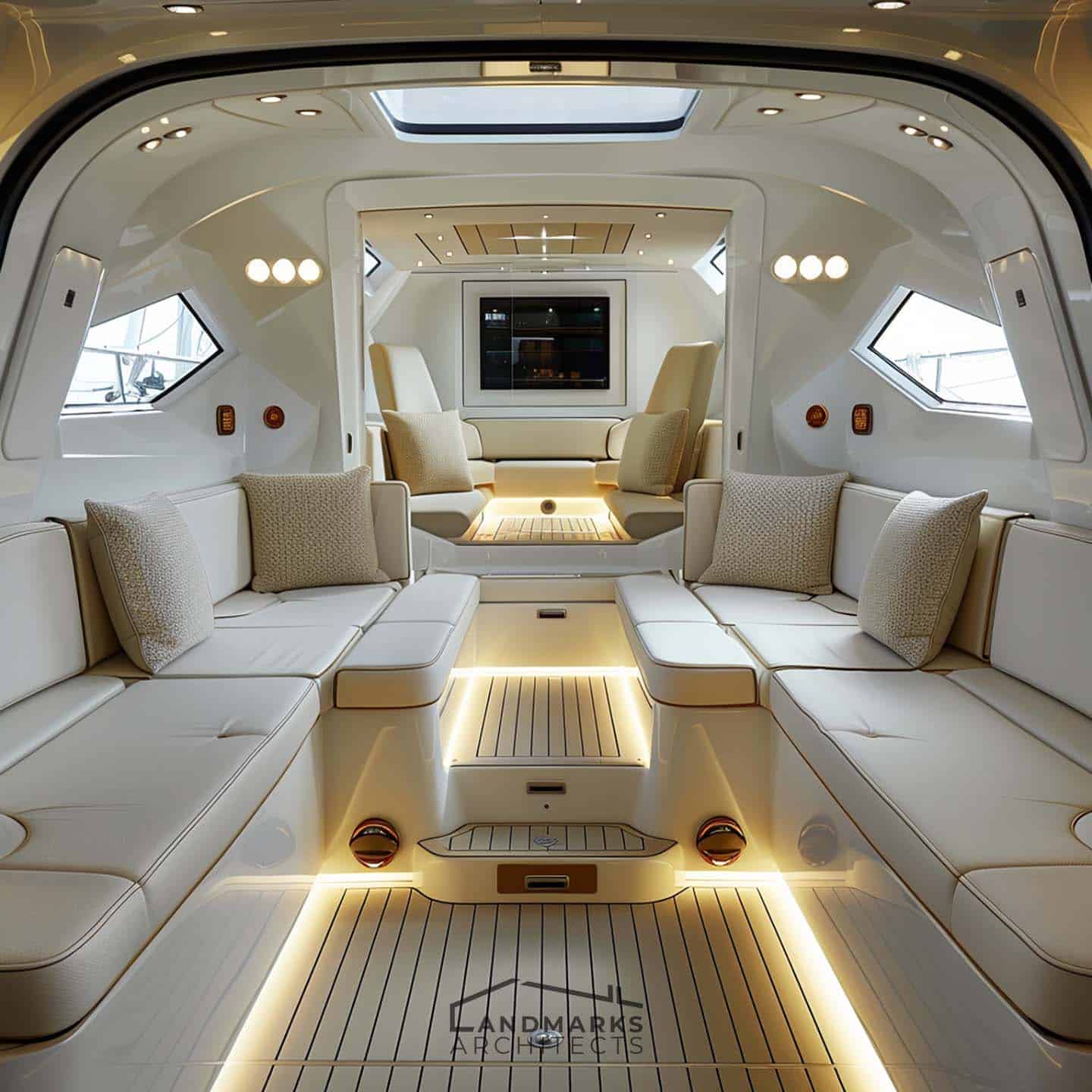
If you only fix one thing, fix lighting. A grey UK afternoon plus one harsh overhead light can make a cabin feel like a cupboard. Warm, layered light can make the same saloon feel like a welcoming little room you actually want to sit in.
The trick is not brightness. It’s control. Good small yacht interior design makes light feel soft, warm, and placed on purpose.
Brightening without glare: warm LEDs, layered lamps, and where to place them
Go warm white rather than cold. Cold light makes everything look clinical and highlights scuffs. Warm light forgives. That matters on a boat.
Use three layers: a general light for moving around, a task light for galley and chart work, and a low glow for evenings. Then add one habit: turn off the harsh overhead light once people settle in. Your saloon instantly feels bigger because shadows soften.
- General: overhead LED, but dimmable if possible.
- Task: galley strip light under shelves, and a chart light.
- Low glow: small lamp or low-level strip near the sole.
Colour rules that work on boats: one calm base, one accent, zero visual noise
Pick one calm base colour for big surfaces, and keep it consistent. Warm off-white, soft grey, and sandy tones often behave better in UK light than stark white.
Then choose one accent colour, and repeat it in small doses. Two cushions, a tea towel, and a mug can be enough. This is the kind of small yacht interior design that feels curated without feeling “done”.
If you love patterns, keep one hero pattern only. Pattern overload looks busy in photos and feels smaller in real life.
Mirrors and reflective touches, but sea-safe and securely mounted
Mirrors work, but do not treat your boat like a house. Anything that can fly will eventually try. Acrylic mirror panels or mirrored film are often safer than glass.
Place mirrors where they reflect light or a tidy surface, not a mess pile. A mirror reflecting clutter doubles the chaos. A mirror reflecting a bright hatch or a clean bulkhead makes the cabin feel longer.
Window treatments that cheat space: sheers, blinds, and how to stop them slapping in a breeze
Loose curtains can look lovely right up until they slap against a portlight at 2 am. If you’ve been there, you know how quickly “cosy” becomes “why did we do this”.
Choose simple blinds or short, secured fabric that stays put. In the UK, damp is real, so prioritise fabrics you can wash and dry easily. In small yacht interior design, washable is a design feature, not an afterthought.
The “photograph test”: if it looks busy in a phone photo, it will feel smaller in real life
Take a quick photo of your saloon and squint at it. If your eye bounces between ten small objects, your brain never relaxes. That’s why the cabin feels smaller than it measures.
This one habit keeps small yacht interior design honest. If the photo looks calm, the cabin usually feels calm.
Improving flow with small yacht interior design: fixing pinch points and awkward movement

Flow is a big ranking gap versus competitor content, because most posts say “declutter” without explaining how movement works onboard. On a yacht, movement is everything. Your cabin feels bigger when you can pass each other without doing the polite sideways dance.
This is where small yacht interior design behaves more like seamanship than decorating. You’re designing a safe, easy route through the boat.
Walkways, companionway clutter, and the “nothing lives on the steps” rule
Make this your unbreakable rule. The steps are a motorway, not a shelf. If you allow “temporary” stuff to live there, it becomes permanent in about five minutes.
If you need a drop zone, create one intentionally. A shallow basket by the hatch works well. That way clutter has a boundary and does not spread.
- Crew call: “Nothing lives on the steps.”
- Drop zone: one basket for arrival chaos, emptied before you cast off.
- Shoe control: one shoe basket near the hatch, not in the saloon.
Zoning a tiny saloon: eating, lounging, drying gear, and guest space without chaos
A saloon that tries to do everything with no zones ends up doing nothing well. Create three zones: a dry lounging zone, a wet kit zone, and a “daily life” zone for charging and snacks.
In UK conditions, wet kit needs a controlled home. Add hooks near the companionway, and a drip tray underneath. Keep damp gear away from cushions. Damp makes cabins feel smaller because it creates areas you avoid.
A smart hosting move is to keep one settee “guest ready”. Clear it, add a blanket, and put a reading light nearby. Guests relax quicker when they know where to sit.
Galley and heads micro-tweaks: hooks, rails, and counter-space rules that stop daily bottlenecks
In a small galley, your counter is either a working surface or a storage shelf. Decide which you want most days. A rule that works is “one appliance out at a time”. Kettle out, toaster away, or vice versa.
Add a rail with hooks for tea towel and daily utensils. It frees counter space instantly, and that is a core small yacht interior design win.
In the heads, keep it brutally simple. One waterproof caddy for daily toiletries. Two hooks. One small basket for spares. Anything else belongs in a locker. The heads feels bigger when it stops being a loose bottle obstacle course.
Storage-first small yacht interior design: making every locker earn its keep
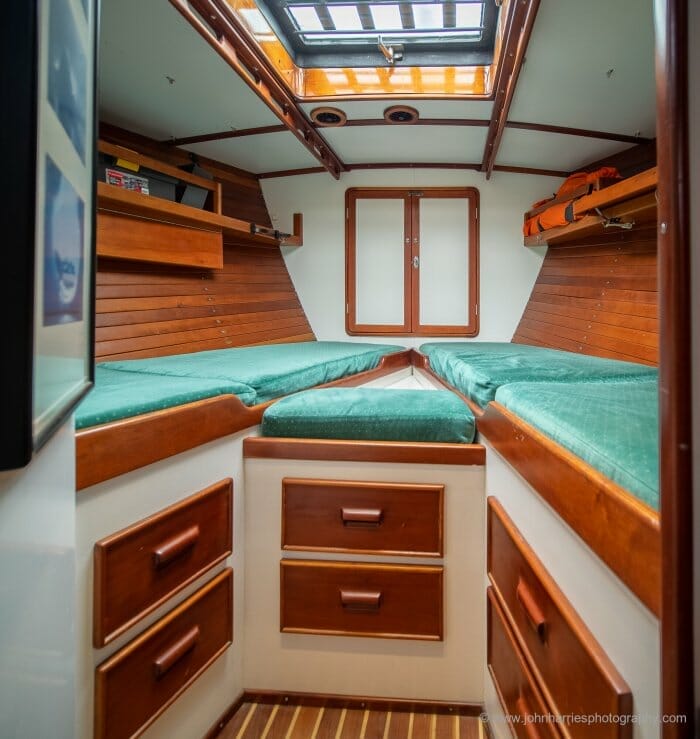
Storage is where your design either survives or collapses. The goal is not “more storage”. The goal is fewer decisions. When your everyday items have obvious homes, clutter stops breeding.
This is also where provisioning becomes dramatically easier. A tidy locker system makes your boat provision planning simpler, because you can see what you have and avoid buying duplicates.
The declutter method that works onboard: keep, relocate, decant, ditch
Here’s the method that works when you have limited time and a cabin full of “just in case”.
Keep means it stays onboard and has a home.
Relocate means it moves to a better locker for its use.
Decant means reduce packaging into sealed tubs.
Ditch means it leaves the boat today.
This is small yacht interior design with a backbone. Duplicates are the real space killer. If you have three half-used bottles of washing-up liquid, you do not have supplies. You have clutter.
| Category | Keep onboard? | Best home | Why it helps space |
|---|---|---|---|
| Dry food staples | Yes, realistic quantity | Low locker near galley | Decanting removes bulky packaging and visual noise |
| Charging kit | Yes, centralise | One labelled basket in saloon | Stops cables spreading across the cabin |
| Cleaning supplies | Yes, minimal | One “turnaround” locker | Fast resets stop mess becoming permanent |
| Wet weather gear | Yes, controlled | Ventilated hanging zone | Damp stays contained, cushions stay dry |
| Tools and spares | Yes, but curated | One roll plus one box | Less rummaging, fewer piles on seats |
Vertical storage, soft organisers, and hidden spaces you’re not using yet
Most yachts have unused vertical space. Locker doors. Bulkheads. The side of the galley unit. Soft organisers and net pockets work well because they conform to odd shapes and do not rattle.
Hidden spaces are brilliant for low-frequency items, but do not hide daily kit. A key small yacht interior design rule is “daily items must be reachable with one hand”. If you have to move three things to reach your head torch, you will stop putting it away.
Labels for real life: guest zones vs owner zones vs turnaround supplies
Labels feel a bit much until you host friends for a weekend. Then labels become the nicest form of hospitality.
Create guest zones for mugs and snacks, owner zones for personal kit, and turnaround supplies for bin bags, wipes, loo roll, and spare batteries. When labels are clear, people stop opening every locker, and the cabin stays calm.
This is also where a boat provisioning template becomes useful. If you label lockers by category, your template becomes a simple tick list, not a memory test.
Furniture and soft furnishings for small yacht interior design that feels larger

Furniture is where owners often overspend. On a 30–45ft yacht, every piece must earn its footprint. If it does not solve a daily problem, it is probably just filling space.
The goal of small yacht interior design is not “more seating”. It is seating and surfaces that do two jobs without being fiddly.
Fold, slide, stack: tables, seating, and convertible ideas that do not feel fiddly
Convertible furniture is brilliant until it becomes annoying. If it takes ten minutes and loose parts, you will stop using it. That’s not a personality flaw. That’s normal human behaviour.
Look for conversions you can do in under two minutes. Drop-leaf tables are classics because they create walking room quickly. Sliding tables can work if they lock securely. Anything that does not lock is not furniture, it’s a problem.
Soft goods that make a cabin feel larger: upholstery textures, bedding feel, and removable covers that stay put
Soft goods change how big a cabin feels because they affect comfort and visual calm. Heavy fabrics can feel cosy but can also visually crowd a small space. Smooth fabrics and lighter tones tend to read as more spacious.
Use removable covers that stay put. If cushions slide, the cabin always looks “mid-mess”, even after you tidy. That undermines your small yacht interior design effort.
For bedding, keep it simple and washable. One calm duvet cover, one accent throw, one spare blanket. In UK weather, the ability to wash and dry quickly is a bigger luxury than a fancy pattern.
Hosting-ready small yacht interior design: comfort upgrades without feeling precious
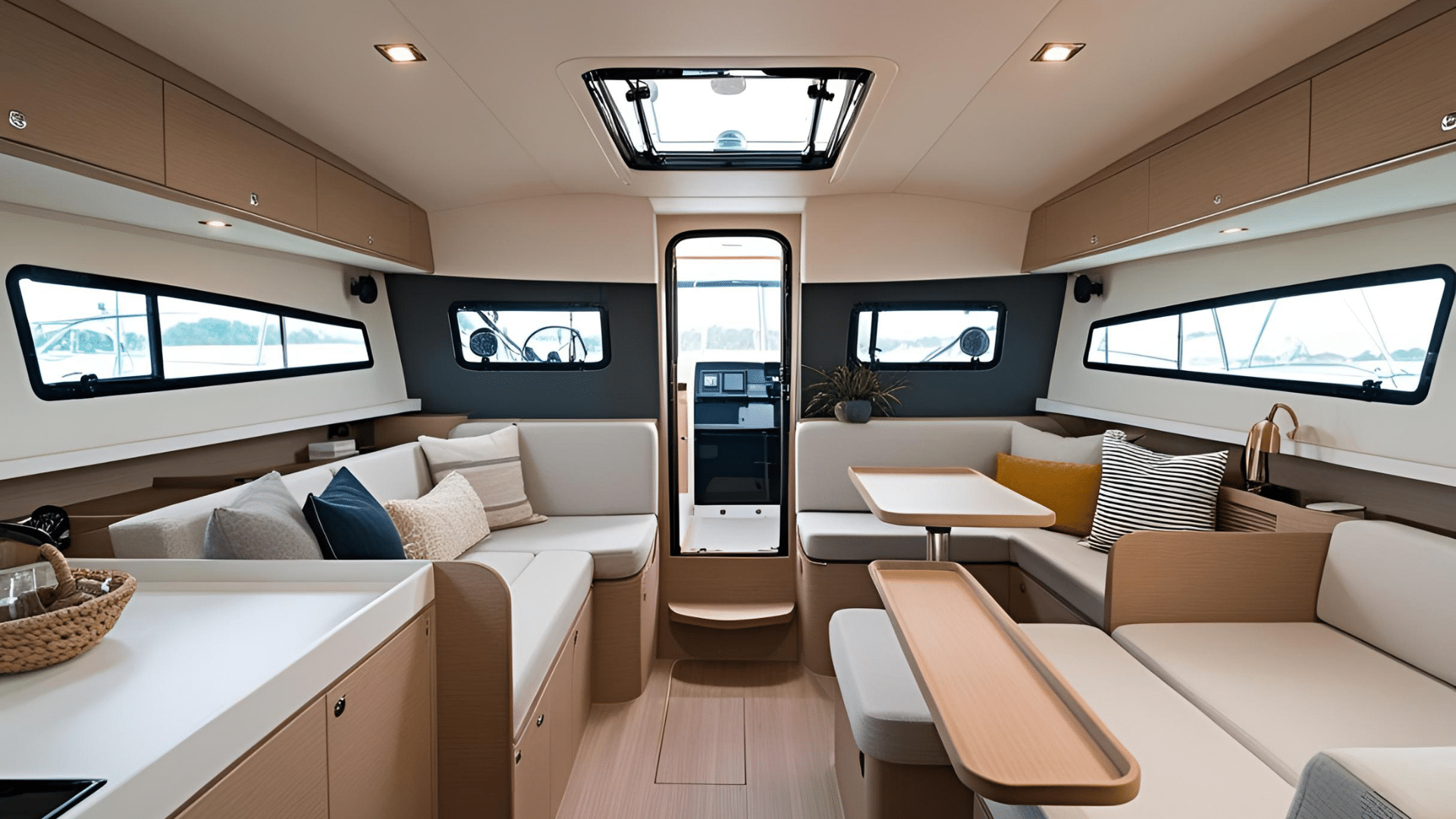
Hosting is where design meets real life. Your cabin feels bigger when guests feel comfortable. Comfortable guests move less awkwardly, ask fewer “where should I put this” questions, and tidy up naturally.
This is where most competitor posts stay vague. Small yacht interior design hosting works when you set up small defaults that guide behaviour.
The hotel-ready basics: bedding, towels, hooks, bins, chargers, and small comforts
Create a guest kit that lives onboard. Two towels. One spare toothbrush. One spare phone charger. One small bin. Add one hook per person in the heads area. People relax when they can hang things up.
Hooks are the underrated hero of small yacht interior design. A towel on a hook looks intentional. A towel on a cushion looks like chaos. Add a shoe basket near the hatch too, because UK weather makes shoe chaos inevitable.
The calm saloon setup: snacks, water station, lighting, and one tidy basket system
Create a snack and water station. A tray with water bottles, mugs, tea, and biscuits. When guests know where things live, they stop rummaging, and your cabin stays tidy.
Then use one tidy basket for daily clutter. Cables, sunglasses, head torch, pen. One basket is allowed. Two baskets becomes a collection. Collections become clutter.
This is a very human small yacht interior design trick because it accepts that daily clutter exists, then gives it a controlled home.
Sea-proof styling rules: nothing fragile, nothing loose, everything washable
If you want trendy styling, do it the sea-safe way. Nothing fragile. Nothing loose. Everything washable. Swap glass for enamel or stainless. Use non-slip mats under trays. Keep décor minimal and meaningful.
In the UK, you’ll also thank yourself for avoiding fabrics that trap damp. A cabin that smells fresh feels bigger, even before you touch storage.
- Choose: washable covers, enamel mugs, lidded boxes.
- Avoid: glass, loose ornaments, fluffy rugs that stay damp.
- Test: if you worry about it when it’s lumpy, it does not belong.
Budgeting small yacht interior design: costs, paint vs wrap, and a realistic reset plan

This is where you stay sensible. Boats are expert-level money vacuums. The trick is to spend where you touch daily, not where you only notice in photos. Small yacht interior design should make life easier every trip, not just look nicer on day one.
Also, if you’re improving storage and routines, your provisioning gets cheaper. Your yacht chandlers runs become more targeted, because you stop buying duplicates you already had buried in a locker.
Budget tiers: quick wins, mid-range refresh, and big impact upgrades
| Tier | Typical spend (UK) | Best upgrades | What it feels like onboard |
|---|---|---|---|
| Quick wins | £50 to £300 | Warm LEDs, hooks, baskets, labels, non-slip mats | Instant calm, fewer shadows, fewer trip hazards |
| Mid-range refresh | £300 to £1,500 | Blinds, removable covers, mirror film, galley rail systems | Cabin feels more “room-like”, easier to host |
| Big impact | £1,500 to £8,000+ | Reupholstery, table changes, surface refresh, joinery tweaks | Noticeable upgrade, but only worth it if systems already work |
How much does it cost to design a yacht? Where the money actually goes on small boats?
On a small yacht, money goes into marine-grade materials and the labour to fit them properly. Measuring and templating in odd spaces takes time. Fixings and finishes need to survive damp, movement, and daily abrasion.
If you DIY, spend where it matters. Good lighting components, proper fixings, and washable textiles. Then keep your styling minimal. Small yacht interior design looks best when it’s functional first.
Is it cheaper to paint or wrap a boat? For a cabin refresh, and which survives life at sea better?
Wrap can be cheaper short-term and looks fresh fast, but edges can lift in humidity if prep is rushed. Paint is slower and smellier, but can be tougher long-term if you prep and ventilate properly.
In UK conditions, condensation is the enemy. Wrap hates damp edges. Paint hates poor curing. Choose what you can finish well, not what seems fastest.
What is a yacht interior specialist? When it’s worth hiring one versus DIY?
A yacht interior specialist understands marine materials, movement, ventilation, and safety. They design for access to batteries, bilge, and seacocks, not just looks.
Hire one for major upholstery, joinery, and fixed furniture changes. DIY the systems: zoning, labels, lighting layers, and storage. Those are the foundations that deliver most small yacht interior design results.
A 7-day New Year reset plan vs a 30-day slow refit plan you can stick to
7-day reset
- Day 1: Audit, photograph test, define zones
- Day 2: Lighting layers, swap bulbs, add a reading light
- Day 3: Steps rule, shoe basket, wet kit hooks and drip tray
- Day 4: Declutter using keep, relocate, decant, ditch
- Day 5: Labels, guest kit, charging basket system
- Day 6: Soft goods refresh, bedding and towels, one accent colour
- Day 7: Sea-proof styling, final tidy basket, fix remaining pinch point
30-day slow refit
- Week 1: Flow and storage foundations
- Week 2: Lighting and surface refresh
- Week 3: Window treatments and soft furnishings
- Week 4: Furniture decisions, only if still needed
If you want to make the reset even easier, keep a simple boat provisioning template inside a locker lid, and update it after each weekend. It sounds nerdy, but it removes mental load, and mental load is a sneaky space killer.
Maintenance habits that keep it feeling big all year: damp control, airing, weekly resets
If you want small yacht interior design to feel bigger all year, treat it like seamanship rather than décor. Air the boat after every trip, wipe condensation before it becomes musty, keep wet kit in a controlled hanging zone with a drip tray, and do a ten-minute weekly reset using your tray and basket system so surfaces stay clear and walkways stay open. Keep your yacht provisioning list and boat provisioning template somewhere visible, and use them to stop “just in case” supplies multiplying, because clutter always returns faster than you expect, especially after a busy weekend run to the yacht chandlers for one small thing that somehow becomes five bags.
Frequently Asked Questions About Small Yacht Interior Design:
🐳My cabin looks tidy, so why does it still feel cramped?
Usually it’s a flow issue, not a mess issue. If your “walking line” is broken by bags near the steps, a blocked galley counter, or a table that’s always half in use, your body reads the space as smaller. Try the two-hand walk test and fix the top two pinch points first.
🐳What’s the quickest “wow” change guests actually notice?
Warm, layered lighting plus a clear companionway. Guests feel calmer when they can move without doing the sideways shuffle, and soft lighting instantly makes the saloon feel more like a room than a corridor. You don’t need fancy fittings, just better placement and a simple on/off routine.
🐳How do I stop the cabin turning into a wet-kit drying cave in UK weather?
Give wet gear a dedicated, ventilated zone near the hatch, and keep it away from cushions and bunks. Add hooks, a drip tray, and an “airing habit” after every trip: open hatches when safe, wipe condensation, and leave locker doors cracked for an hour. Damp control is the secret to keeping a small cabin feeling roomy.
🐳Should I paint, wrap, or just clean and call it a day?
If your main issue is clutter and shadow, start with cleaning, lighting, and storage systems first. Paint or wrap can look brilliant, but it won’t fix blocked surfaces or messy routines. If you do refresh surfaces, pick the option you can prep properly and keep edges dry, because poor prep always shows faster onboard.
🐳What’s the most underrated storage trick for small yachts?
One “daily life” tray or basket with a strict boundary. It sounds simple, but it stops cables, sunglasses, keys, and snacks spreading across the saloon. Pair that with clear labels for guest-friendly lockers, and you’ll spend less time hunting and more time actually enjoying the boat.
References
- Jake Kavanagh. (11 December 2025). Banish damp from your boat this winter. Practical Boat Owner. https://www.pbo.co.uk/expert-advice/banish-damp-from-your-boat-this-winter-100411
- Vaughan Marsh. (2025). Winterising top tips. Royal Yachting Association. https://www.rya.org.uk/blog/winterising-top-tips
- Kerry Buchanan. (20 December 2024). How to prepare your boat for a dream voyage. Practical Boat Owner. https://www.pbo.co.uk/expert-advice/how-to-prepare-your-boat-for-a-dream-voyage-92221
- Carolyn Shearlock. (4 January 2025). Downloadable Provisioning Spreadsheet for Boaters. The Boat Galley. https://theboatgalley.com/downloadable-provisioning-spreadsheet/
- Brian Johnson. (12 June 2023). DIY installation of LED boat lights. Practical Boat Owner. https://www.pbo.co.uk/practical-projects/diy-installation-of-led-boat-lights-76833
- Joe Lombard. (24 November 2025). LED Marine Lighting: The Complete Guide to Bright, Efficient, and Durable Solutions. DRSA. https://www.drsa.com/blogs/news/led-marine-lighting-guide-efficient-durable-solutions
- International Yacht Paint (AkzoNobel). (7 April 2025). Boat Paint Guide: UK Edition. International Yacht Paint. https://media1.svb-media.de/media/snr/521138/pdf/manual_2025-04-07_13-59-09_3b4c0a81b06107057aa278836534740b.pdf
Boat Interior: The 2026 New Year Reset Checklist for Guest Amenities & Consumables
Best Sailing Books for Beginners: 18 titles that make sailing finally make sense
Sailing Maneuvers: Essential Skills Every Beginner Should Know
Comments are closed